Notebook 01 · masonry and foundations
Rock towers: building where the sea breaks
A tower on a tide-covered reef has no site in the ordinary sense. No harbour. No level ground. A working day set by the water. The design answers those conditions before it answers anything else.
The problem in plain terms
A reef tower carries two loads that a shore tower does not. Direct wave impact. And suction as the water falls away. Impact tests the mass. Suction tests the joints. A wall that merely stands up will be dismantled stone by stone from the outside.
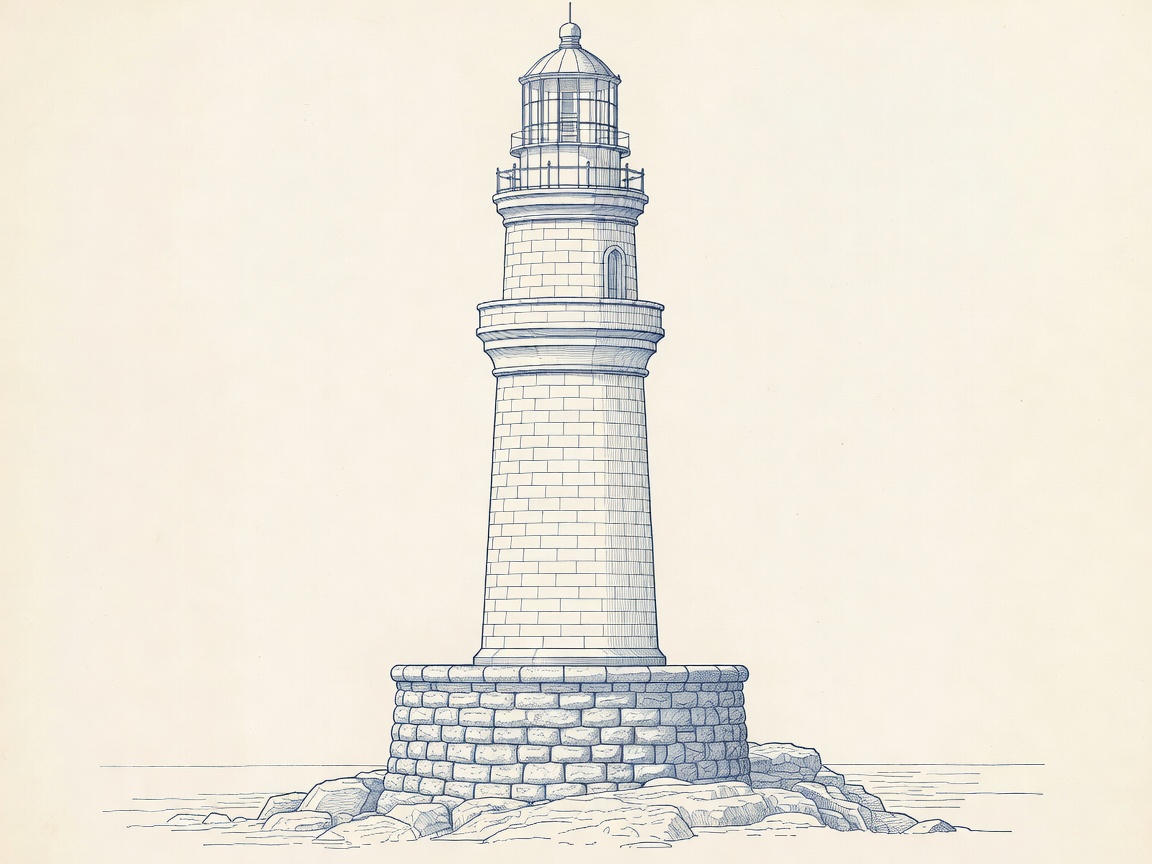
So the answers are consistent across every successful example. Get weight low. Lock the stones to each other, not just to the bed below. Make the lowest section solid, with no internal voids, so the tower behaves as one block. Curve the profile so water runs up the face rather than striking it square. Keep the door above the worst of the run-up.
Eddystone: four towers on one reef
The Eddystone rocks lie south-west of Plymouth, awash at high water. Henry Winstanley's tower stood there first, timber and iron, ornate, and it was lost with its builder in the great storm of 1703. John Rudyerd's replacement was a timber cone weighted with ballast, plainer and better shaped for the sea. It burned in 1755.
John Smeaton's tower followed, first lit in 1759, and it set the pattern everything afterwards borrowed. Granite and Portland stone. Courses dovetailed into each other on plan, so no block could be drawn out alone. Marble dowels and oak trenails pinning course to course. Hydraulic lime that sets in wet conditions. A profile flared at the base and tapering above, modelled on the trunk of an oak. The rock itself was dressed into steps and the first courses keyed into them.
Smeaton's tower outlasted its foundation rock, which was undermined by the sea. James Douglass built the fourth tower on an adjacent rock, completed in 1882, taller, with a cylindrical solid base carrying the dovetailed shaft above. The upper part of Smeaton's tower was taken down and re-erected on Plymouth Hoe, where it still stands and can be climbed.
Bell Rock and Skerryvore
The Inchcape, or Bell Rock, lies off the Angus coast and covers at every tide. Robert Stevenson built there for the Northern Lighthouse Board, with John Rennie appointed as consulting engineer, and the light was first exhibited in 1811. The constraint was time. Work only at low water, in short windows, with a beam barrack raised on legs above the rock so the men were not ferried back to the tender each tide. Stone was dressed ashore, numbered, and shipped out to be set. The base is solid; the dovetailing follows Smeaton's principle.
Skerryvore sits on gneiss reefs south-west of Tiree, in heavier Atlantic water. Alan Stevenson's tower was completed in the 1840s. The first temporary barrack was swept away and had to be rebuilt. The profile differs from Smeaton's concave curve: Stevenson used a hyperbolic taper, which puts more mass low down and reads as a straighter, more severe line. Granite came from Hynish on Tiree and from the Ross of Mull. A fire gutted the tower in 1954; it was rebuilt internally and relit later that decade.
Fastnet
The Fastnet Rock stands off Cape Clear in County Cork, the last Irish land on the westward passage. The first tower there was cast iron, erected in the 1850s, and it flexed unnervingly in gales. The replacement, designed under William Douglass for the Commissioners of Irish Lights and completed in the early twentieth century, is Cornish granite. Its courses are dovetailed on plan and keyed vertically as well, so blocks lock downward into the course beneath. The lower courses are the heaviest in the tower. The base is solid.
South Stack, for contrast
South Stack sits on a small island at the foot of the cliffs on Holy Island, Anglesey, and was first lit in 1809, built for Trinity House to a design by Daniel Alexander. The tower is not wave-swept in the Eddystone sense. Its problems are different: getting people and stores down a long flight of steps and across the gap to the island, and the fog that rolls onto that coast. The comparison is the point. Site dictates form. A cliff-foot station can afford a slender tower and put its difficulty into access instead.
| Tower | Waters | Engineer credited | Structural note |
|---|---|---|---|
| Eddystone | Off Plymouth, Devon | John Smeaton, later James Douglass | Dovetailed courses; fourth tower on a cylindrical solid base |
| Bell Rock | Inchcape reef, off Angus | Robert Stevenson | Built in tidal windows from a barrack on legs |
| Skerryvore | Reefs off Tiree, Inner Hebrides | Alan Stevenson | Hyperbolic taper; island granite |
| Fastnet | Off Cape Clear, County Cork | William Douglass | Cornish granite, dovetailed and vertically keyed |
| South Stack | Holy Island, Anglesey | Daniel Alexander | Cliff-foot station; access by steps and bridge |
Trade-offs worth noticing
Mass against elasticity. Granite resists impact and stays still; cast iron is quicker to erect and cheaper to ship, but a slender iron tower moves, and movement unsettles both keepers and apparatus. Solid base against usable volume: every metre of solid masonry is a metre of stair you do not have. Curve against cost: a shaped tower needs every block cut individually to a template.
Later work adds its own compromises. Helideck platforms fitted above some rock-tower lanterns solved the relief problem and altered both the silhouette and the light's upward arc. Concrete repairs sit alongside original lime mortar with different movement and different weathering.
Looking at a tower
Read the base first. Batter, set-off, and the height of the door tell you what the sea does there. Then the joints: dressed granite with fine joints is a different engineering culture from rubble and render. Then the top: gallery brackets, lantern glazing pattern, and whether the astragals are straight or helical.