Notebook 04 · who runs the lights
Three authorities, one system of dues
Lighthouses in these islands are not run by one body, and never have been. Three general lighthouse authorities hold the seaward marks. Harbour authorities hold the rest. The money comes from shipping.
Trinity House
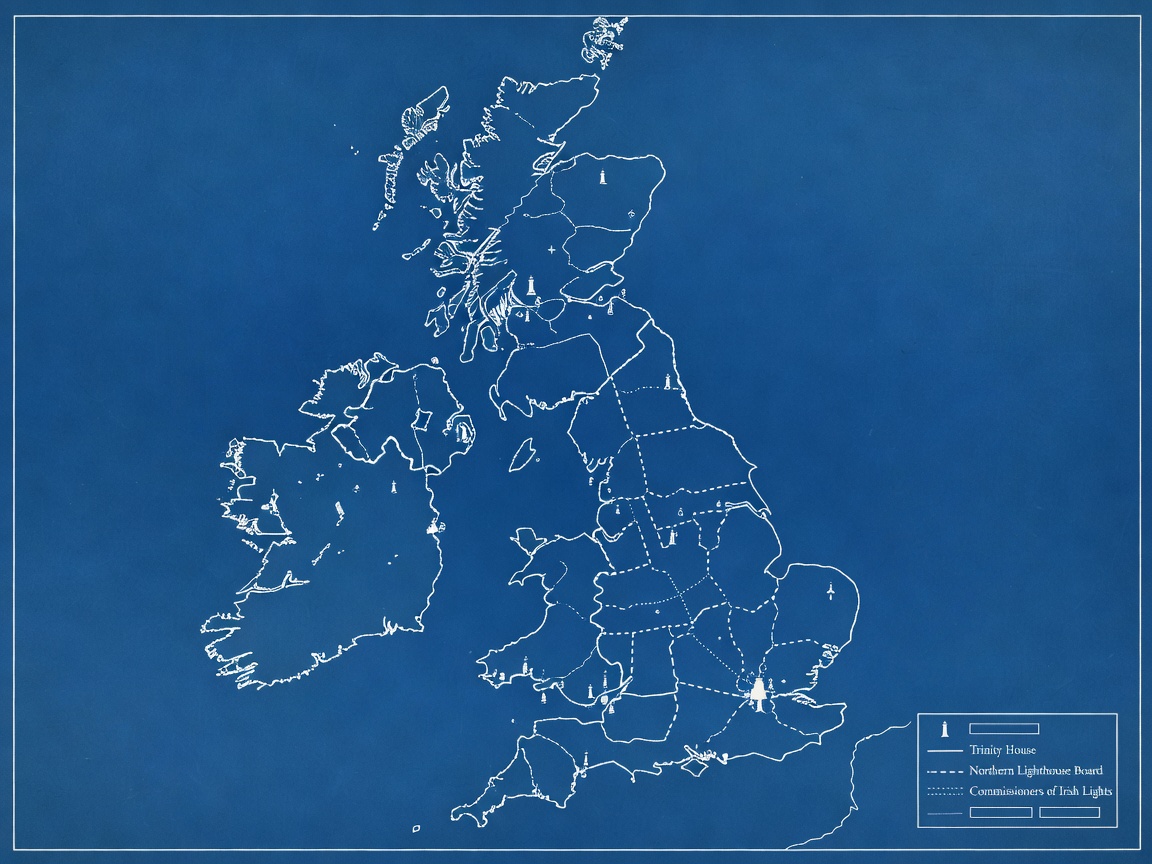
The Corporation of Trinity House holds its origins in a royal charter granted by Henry VIII in 1514, and it is the general lighthouse authority for England, Wales, the Channel Islands and Gibraltar. It maintains lighthouses, lightvessels, buoys and beacons, inspects local aids to navigation, and operates tenders for servicing them. Its operational base is at Harwich in Essex, and it also functions as a maritime charity and as a deep-sea pilotage authority, roles that sit alongside the lighthouse service rather than inside it.
The Northern Lighthouse Board
Established by Act of Parliament in 1786 as the Commissioners of Northern Lighthouses, the Board is the general lighthouse authority for Scotland and the Isle of Man. Its headquarters are in Edinburgh, with a principal operating base at Oban. Its commissioners are largely ex officio — holders of specified public offices — rather than appointees, which is an unusual constitution among British public bodies and a direct inheritance from its founding statute.
The Commissioners of Irish Lights
Irish Lights is the general lighthouse authority for the whole island of Ireland, north and south, a single all-island body whose remit was not partitioned. Its work descends from the lighthouse responsibilities of the Dublin Ballast Board, and it was constituted as the Commissioners of Irish Lights in the 1860s. Its base is at Dún Laoghaire, County Dublin. Alongside its statutory aids to navigation it has developed public access to a number of stations through the Great Lighthouses of Ireland initiative.
| Authority | Area of responsibility | Basis | Principal base |
|---|---|---|---|
| Trinity House | England, Wales, Channel Islands, Gibraltar | Royal charter of 1514, with later statute | Harwich, Essex |
| Northern Lighthouse Board | Scotland and the Isle of Man | Act of Parliament, 1786 | Edinburgh, with an operating base at Oban |
| Commissioners of Irish Lights | The island of Ireland, north and south | Nineteenth-century statute, succeeding the Dublin Ballast Board | Dún Laoghaire, County Dublin |
Light dues and the General Lighthouse Fund
General aids to navigation are not funded from general taxation in the ordinary way. They are paid for through light dues, a charge levied on commercial vessels calling at ports, which flow into the General Lighthouse Fund. The authorities draw their running and capital costs from that fund, and the arrangement is overseen by the Department for Transport. The principle is that the shipping which benefits pays, rather than the taxpayer at large.
The funding relationship with Ireland has been revised more than once since partition, and the division of cost between the fund and the Irish state is a matter of intergovernmental arrangement rather than a fixed historical constant. Anyone needing the present position should take it from the authorities and the Department for Transport directly, not from a summary.
Where a harbour authority takes over
The general lighthouse authorities look after the seaward marks that serve general navigation. Port and harbour authorities are responsible for local aids within their own limits: pier-head lights, leading lights, channel buoyage, and so on. The general authorities retain a statutory inspection role over those local aids, which is why a small harbour light that fails will eventually attract attention from outside the harbour.
Two further distinctions are worth holding. Aids to navigation are not the same as search and rescue, which is a separate function. And a lighthouse that has been discontinued as an aid may still stand, still be lit for heritage reasons, and still be maintained — but it is no longer part of the navigational system.
Engineering families
The technical history of these three bodies runs through a small number of families. In Scotland, the Stevensons served the Northern Lighthouse Board across generations: Robert on the Bell Rock, Alan at Skerryvore, and Thomas and David on later towers and on optical design. For Trinity House, the Douglass family carried much of the Victorian rock-tower work, including James Douglass at Eddystone. In Ireland, George Halpin senior directed a long programme of lighthouse construction for the Ballast Board, and the Douglass name reappears with William Douglass on the Fastnet.
That concentration explains a good deal of the stylistic consistency. Details recur from tower to tower because the same offices designed them, refined them and reused what worked.
Going to the source
Each authority publishes its own notices, station information and heritage material: Trinity House, the Northern Lighthouse Board and the Commissioners of Irish Lights. For anything navigational, pair those with a corrected chart and the Admiralty List of Lights.