Working notes · towers, lenses, light
Lighthouses of Britain and Ireland, drawn from the stone up
Five sets of notes. Masonry that stands in breaking sea. Glass that bends a lamp into a beam. Timed flashes that name a rock. Three statutory bodies. And the long withdrawal of the keepers.
Plain description, no romance. What a tower is made of. Why its base is solid. How a lens with the right prisms throws light to the horizon instead of the clouds. Where to check a light's character before you trust it.
Guide index · five notebooks
Where to start
Each entry below is a separate notebook. Read them in any order. They cross-reference where the subjects overlap.
-
01 · Masonry and foundations
Rock towers: Eddystone to Fastnet
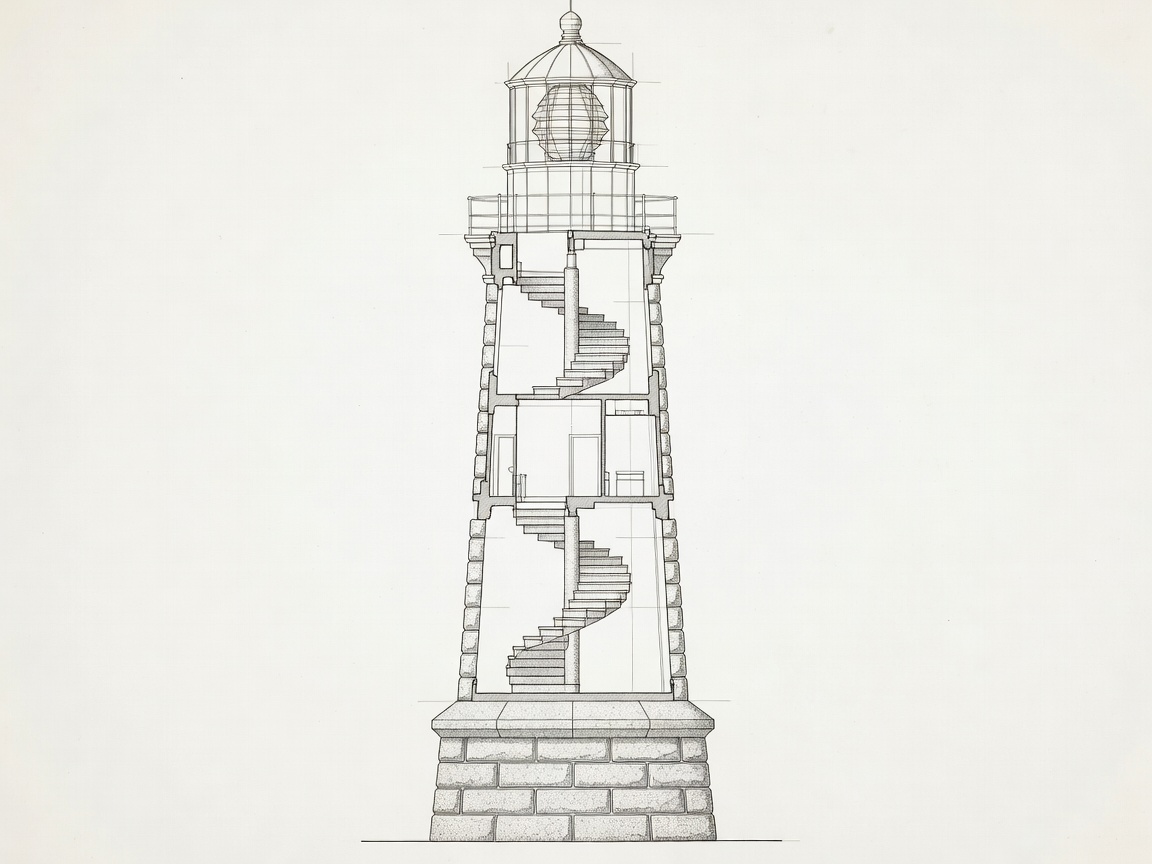
Four towers on the Eddystone reef, John Smeaton's dovetailed granite among them. Robert Stevenson on the Inchcape at Bell Rock. Alan Stevenson's hyperbolic profile at Skerryvore, off Tiree. William Douglass's granite tower on the Fastnet, off Cape Clear. Cliff-foot work at South Stack for comparison.
Open the notes -
02 · Lenses, lamps, rotation
Optics: reflectors, Fresnel lenses, drives
From coal fire and Argand lamp with parabolic reflector to Augustin-Jean Fresnel's stepped dioptric panels and the catadioptric prisms that followed. Lens orders. Clockwork drives, weight tubes and mercury float bearings. Illuminants from colza oil to paraffin vapour to LED.
Open the notes -
03 · Identification at sea
Light characters and how to read them
Fixed, flashing, group flashing, occulting, isophase, quick. Period, colour, sectors. Nominal against geographical range. Fog signals, racons and AIS aids to navigation. Why the United Kingdom Hydrographic Office Admiralty List of Lights, not memory, settles what a light is doing.
Open the notes -
04 · Who runs the lights
Trinity House, the Northern Lighthouse Board, Irish Lights
Three general lighthouse authorities, three jurisdictions, one General Lighthouse Fund raised from light dues on commercial shipping. Charters and statutes. Engineering families: the Stevensons in Scotland, the Douglasses for Trinity House, the Halpins in Ireland. Where harbour authorities take over.
Open the notes -
05 · Keepers withdrawn
Automation and the modern station
Electrification, sealed-beam arrays, lamp changers, telemetry, solar panels and battery banks. Helidecks over rock-tower lanterns. South Stack's keepers withdrawn; North Foreland, Fair Isle South and the Baily as the last manned stations of their services. What an automated tower looks like from the path.
Open the notes
Vocabulary · terms used throughout
Words on the drawing
Short definitions. They recur across all five notebooks, so they sit here rather than being repeated.
- Catoptric
- Light gathered by mirrors. Typically a lamp at the focus of a polished parabolic reflector.
- Dioptric
- Light gathered by refraction through glass. The stepped Fresnel lens belt is the classic case.
- Catadioptric
- Both together. A central lens belt with reflecting prisms above and below to catch stray rays.
- Character
- The timed pattern of light and dark that identifies one light and distinguishes it from its neighbours.
- Period
- The time taken for one complete cycle of the character, dark intervals included.
- Set-off
- The stepped shoulder where a solid base meets the tapering shaft. Sheds water and breaks wave run-up.
- Dovetailing
- Stones cut to interlock with their neighbours so a course resists being drawn out by wave suction.
- Sector light
- Coloured arcs thrown over defined bearings. One colour marks a safe approach, another a hazard.
On figures and current status
Heights, ranges and characters change with refits, and a light can be altered or discontinued. These notes stay with structure, method and documented history. For what any light is doing now, the Admiralty List of Lights and Radio Signals and the relevant authority's own notices are the sources to use.