Notebook 02 · lenses, lamps, drives
Optics: turning a flame into a beam
A bare flame wastes almost all of itself. It lights the sky, the sea beneath, the lantern glass. The whole history of lighthouse optics is the business of collecting those rays and laying them flat along the horizon.
Before glass: fires and reflectors
The earliest sea marks burned coal or wood in open grates. Bright in still air, useless in rain, and impossible to characterise. Enclosure came next, with candles and then oil lamps behind glazing.
The real gain was the Argand lamp: a tubular wick with air drawn up the centre, giving a steadier, hotter, brighter flame than a flat wick. Put that lamp at the focus of a silvered parabolic reflector and you have a catoptric apparatus. Mirrors gather the rays that would otherwise be lost. Several reflectors can be mounted on a frame and turned, each sweeping the horizon in turn.
Limits appear quickly. A mirror loses light at every reflection, tarnishes in a salt atmosphere, and needs constant polishing. A reflector's beam is also hard to shape precisely. Reflector stations demanded many units and a great deal of keeper labour.
Fresnel and the dioptric lens
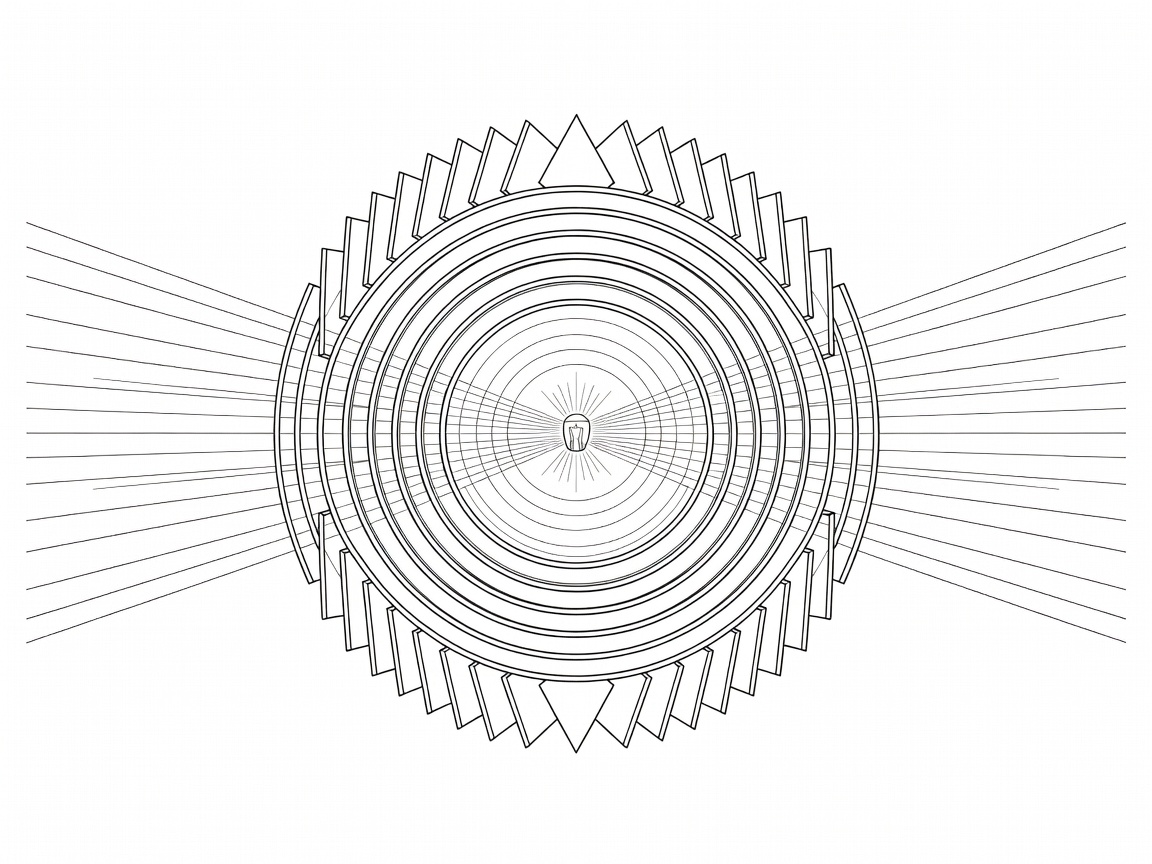
Augustin-Jean Fresnel's contribution was to strip a lens back to the parts that do the work. A conventional lens thick enough for this duty would be impossibly heavy and would absorb much of the light. Fresnel cut the curved surface into concentric annular steps, each carrying the correct angle, with the bulk removed. The result refracts as a single large lens would, at a fraction of the glass. The arrangement was first installed at the Cordouan light, at the mouth of the Gironde in France, in the 1820s, and spread through British and Irish practice over the following decades.
Above and below the refracting belt, rays leave at angles too steep for refraction alone. Those are caught by prisms that reflect and refract them back to the horizontal. A belt with prisms is a catadioptric apparatus. In Scotland, Thomas Stevenson developed holophotal arrangements intended to recover as much of the source output as possible into the beam, and Alan Stevenson brought the large dioptric apparatus into Northern Lighthouse Board practice at major stations.
Orders, and why size matters
Fresnel apparatus is classified by order, which is set by the focal distance from the lamp to the inner face of the lens. First order is the largest of the standard orders, used at landfall and major coastal stations; the smaller orders serve harbour and secondary lights. Larger orders were later built for exceptional stations, sometimes described as hyper-radial.
Bigger is not automatically better. A larger optic collects more of the source and produces a narrower, more intense beam, but it needs a bigger lantern, a wider tower head and a heavier rotation mechanism. That works its way straight down into the masonry. Selection has always been a negotiation between the range required, the height available and what the structure can carry.
Making it flash: drive mechanisms
Fixed lights need no motion. Characters do. The standard solution was a rotating optic: the lens panels turn around a stationary lamp, and each bull's-eye sweeps a beam past the observer. The number of panels sets the number of flashes in a group; the speed of rotation sets the period.
Rotation came from clockwork. A weight descended a tube through the centre of the tower, driving a train of gears through a governor. The keeper rewound it on a schedule through the night, which is one reason keepers were kept on watch rather than asleep. Friction was the enemy. Roller and ball races helped. Floating the whole rotating assembly in an annular bath of mercury helped more: an almost frictionless bearing that allowed heavy optics to turn fast enough for short periods. Mercury baths later became a handling and disposal problem in their own right, and many have been removed during refits.
Occulting characters take another route. Rather than sweeping a beam past you, a shade or eclipser interrupts a fixed light at intervals, so the light is on longer than it is off.
Illuminants, in sequence
- Animal and vegetable oils, including sperm oil and colza, burned in multi-wick Argand-type lamps.
- Mineral oil, cheaper and more available, once burners were adapted to it.
- Paraffin vapour burners with incandescent mantles: pressurised, vaporised fuel giving a far brighter, more compact source.
- Electric arc and later filament lamps, where a station could be supplied or could run generators.
- Sealed-beam arrays and, later, light-emitting diodes: low power, long service life, well suited to solar and battery supply.
The modern trade-off
A classical optic with a modest lamp can out-range a compact modern array. But it demands rotation machinery, a large lantern, cleaning and skilled attendance. An LED array demands almost nothing and will run for years on panels and batteries, at the cost of range and, to many eyes, of character quality. Authorities have replaced many optics on those grounds while retaining rotating apparatus at significant landfall stations.
Seeing apparatus at close range
Decommissioned optics are held in museum collections rather than left in situ. The Museum of Scottish Lighthouses at Kinnaird Head, Fraserburgh, keeps a substantial lens collection with the station attached to it, and several Irish stations open to visitors through the Great Lighthouses of Ireland network retain or display apparatus. Check opening arrangements with each site before travelling.