Notebook 05 · keepers withdrawn
Automation: the station without the watch
Automation is not one invention. It is a long substitution of equipment for attendance, finished only when nothing in the tower needed a hand on it through the night.
What the keepers were actually doing
Start with the labour, because that is what had to be designed out. Trimming wicks and mantles. Pressurising and refilling paraffin vapour burners. Rewinding the clockwork drive that turned the optic. Watching for a lamp failure and changing it at once. Starting the fog signal engines when visibility closed in. Cleaning salt and soot from the lantern glazing. Logging weather. Keeping stores, and keeping each other sane on a rock relief.
Each of those is a separate engineering problem. Automation arrived piecemeal, in the order the problems could be solved.
The enabling steps
- Electrification. A mains supply or a generator removes the burner ritual entirely and makes remote switching possible.
- Automatic lamp changers. A carousel of lamps that indexes a fresh one into the focus when a filament fails, so a single failure is no longer an emergency.
- Photoelectric switching. The light turns itself on and off at threshold illumination, with no keeper to judge dusk.
- Electric motor drives. Rotation without a falling weight and without the rewind.
- Fog detectors. Automatic sensing of visibility to start and stop a sound signal.
- Telemetry. A radio or landline link reporting lamp status, power state and faults to a monitoring centre.
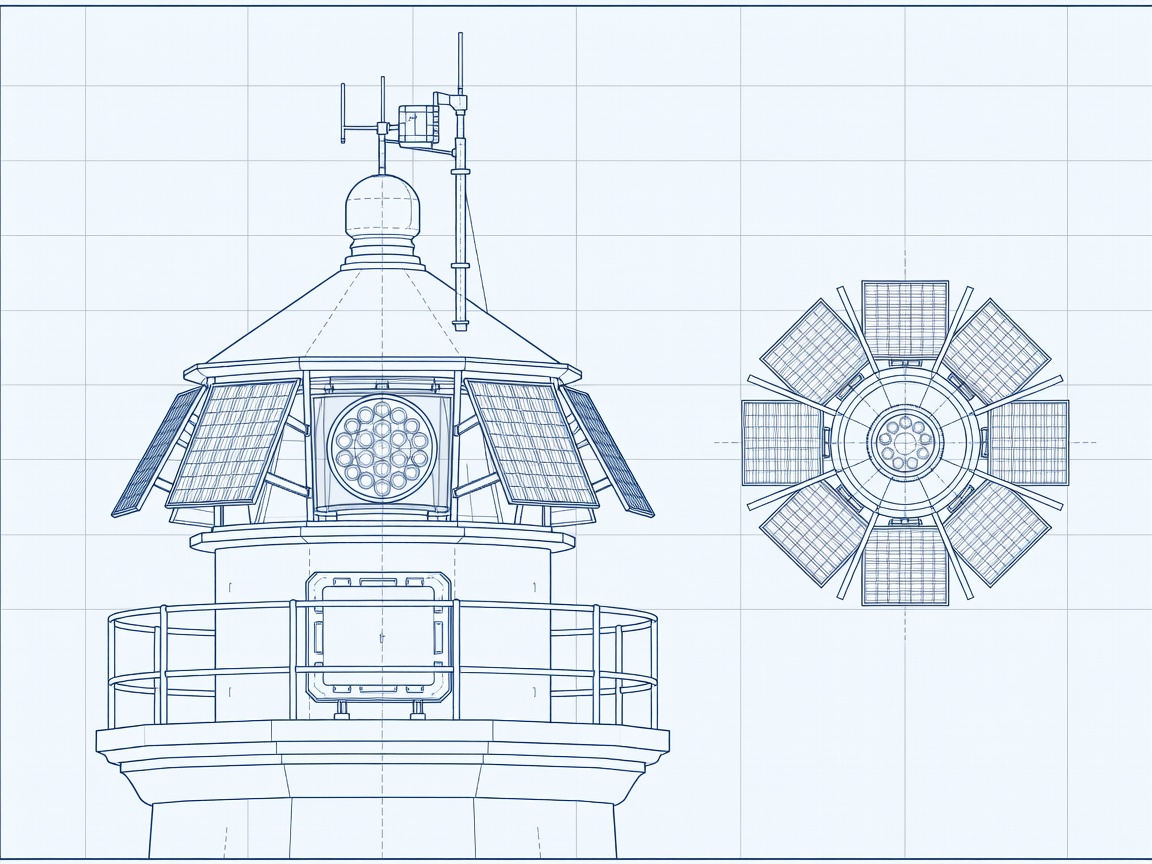
- Solar arrays and battery banks. With low-power sealed-beam and later LED sources, an isolated station can be self-sufficient for long periods.
Access, and the helideck
Relieving a rock tower by boat depends on sea state, and reliefs were often delayed for days. Helicopter relief changed that, and several rock towers were fitted with platforms above the lantern to take an aircraft — Eddystone among the first in the Trinity House service. The engineering is awkward: a deck above the lantern intrudes on the light's upward arc and adds wind loading at the worst possible height. It was accepted because it made both relief and, later, maintenance of an unmanned tower practical.
The end of manned keeping
Withdrawal of keepers ran through the later twentieth century, station by station, as each was converted. South Stack on Anglesey was automated in the mid-1980s. The final manned stations were reached in the 1990s: Trinity House's last keepers left North Foreland in Kent in 1998, the Northern Lighthouse Board's last manned station, Fair Isle South, was automated in the same year, and the Commissioners of Irish Lights withdrew their last keepers from the Baily on Howth Head in 1997.
After that, attendance became scheduled maintenance. Technicians visit on a cycle, or in response to a fault alarm, and the station is otherwise monitored from a control room ashore.
What automation cost
Reliability improved and running costs fell, but there were trade-offs and they are visible.
- Range. Low-power arrays generally throw less far than a large optic with a powerful source. Where a long range is no longer judged necessary, the authority accepts a shorter one.
- Apparatus. Many classical lenses were removed during conversion. Some went to museum collections; some rotating optics were kept in service at major landfall stations.
- Fabric. A building with nobody in it is a building nobody is heating, ventilating or noticing. Damp, corrosion and bird damage progress unobserved between visits.
- Local knowledge. A keeper reported wrecks, weather and casualties from a vantage point that is now unoccupied.
- Estate. Keepers' cottages were sold, let as holiday accommodation or repurposed, which is why so many stations now have private houses inside the compound wall.
The station in the wider system
Lighthouses no longer stand alone. Vessels navigate primarily by satellite positioning, with radar and electronic charts, and the visual mark has become a check rather than the primary fix. That has pushed the authorities into reviewing which lights are still required, and at what range — a continuing process of assessment rather than a single decision. The general lighthouse authorities have also worked jointly on the vulnerability of satellite navigation to interference, and on terrestrial systems and monitoring intended to sit behind it.
Reading an automated station from the path
Signs are consistent. A small lamp array or a compact optic where a large lens once filled the lantern. Solar panels on the gallery rail or on a frame in the compound. An aerial or dish for telemetry. Brackets and a blanked-off mounting where a fog signal emitter used to sit. Locked doors and an intercom. Grass where a vegetable garden was. And, often, a very well-kept cottage that is somebody's home.
Visiting
Operational stations are working sites with restricted access. Some are open to visitors through the authorities' own heritage arrangements, and lighthouse cottages at a number of Irish stations are let as accommodation. Check access with the relevant authority before planning a trip, and stay off cliff paths and rock platforms in heavy weather.